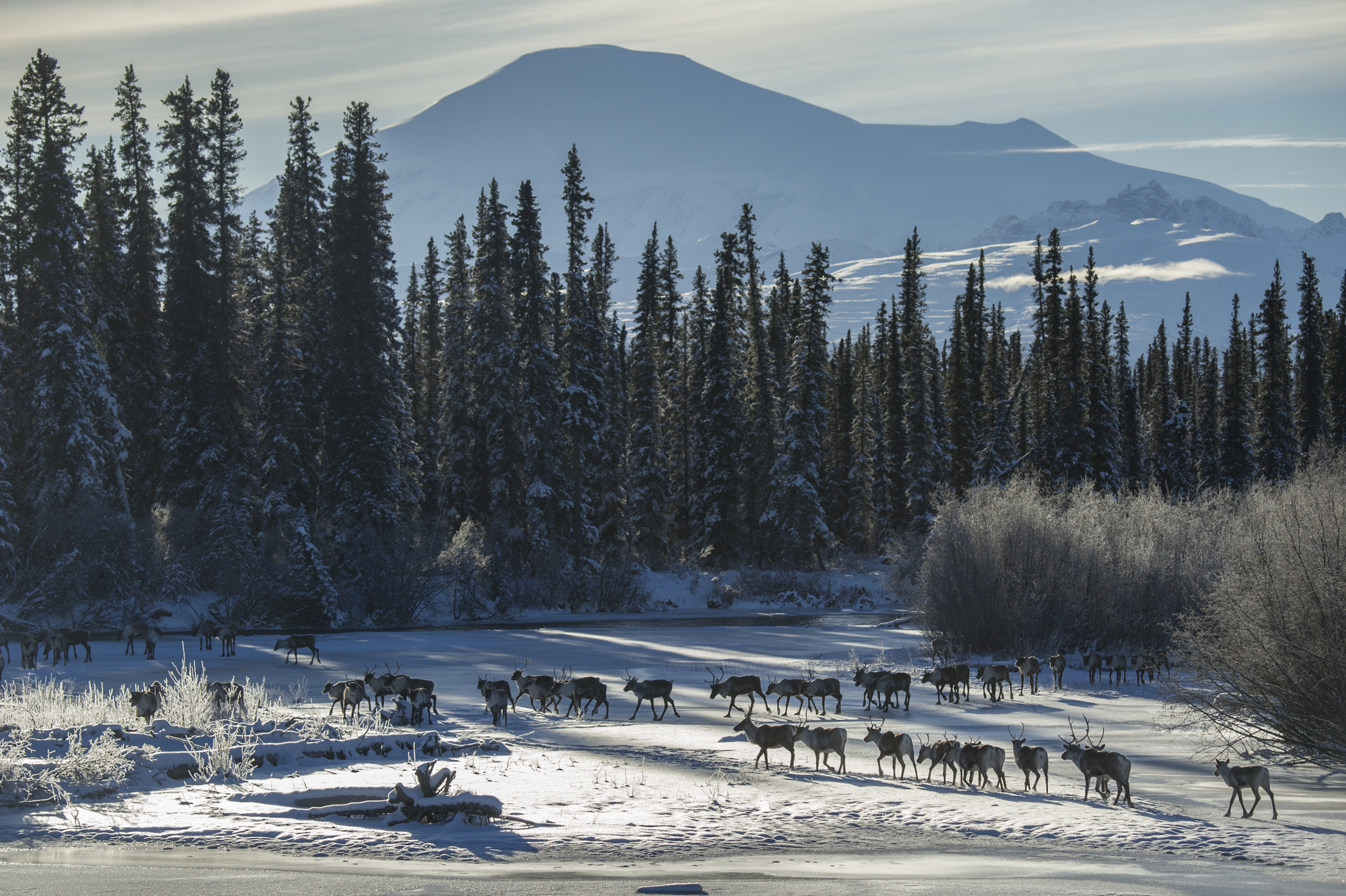
For two weeks I’d waited along this frozen river in the hopes of photographing the semi-annual caribou migration. I saw about two hundred caribou, a mere trickle compared to some years. One large group had close to one hundred fifty caribou and the remaining stragglers were in pairs or small groups. The bulk had passed to the west of here earlier.

Alaska
I knew from past migrations that the freezing rivers naturally funnel the caribou to this big bend in the Copper River Basin. The river, frozen on both sides, was still open in most places down the middle. I had located four likely places on the big bend where caribou had crossed, places with enough cover for a photo ambush. I moved between my ambush points to stay warm and pack down the trail between them so I could quickly move from one to another. I think about others who had probably waited along the big bend in the Slana River to ambush caribou, Ahtna hunters. Just yards away there are old blaze marks on big spruce trees marking the trail from the mouth of the Slana River to Batzulnetas village about five miles upriver. In 1848 Ahtna warriors killed the entire group of Russian Soldiers near Batzulnetas. On most days I saw no caribou. The caribou was painfully slow, but action could come at any moment.

And when caribou are suddenly bearing down on my hide, I start forgetting things. Things like warm cabin, cold feet, and how to operate a camera. Luckily symptoms of buck fever are temporary.

Of course more often than not the caribou would decide to cross where I wasn’t. With tripod and camera over my shoulder I hurried down my trail trying to get in camera range. Out of time and breath, I planted the tripod like a mono-pod into the snow and clicked away as they plunged in and swam across.

When I first noticed the caribou calf, it was in the river being carried past me by the current. He managed to climb onto an ice island in the middle of the river. After a couple of minutes he struggled to stand. Even though exhausted, the six month old calf, separated from his mom, was pressed by the urge to keep going. Walking to the edge of the ice he stepped in with a plop and swam across the ten feet of open water but did not attempt to climb out. Instead he turned back to the island, climbed out, laid down and curled up.


The calf was in trouble. I stayed hidden knowing if he saw me now he might panic and jump back into the dangerous river. Resting now would increase his odds for survival. The six month-old calf was still asleep on the ice as the winter light faded. As I slowly moved away my gut told me this young caribou was a survivor.